how much salt is in the ocean per cup
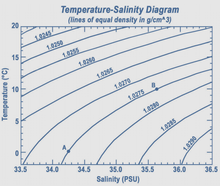
Temperature-salt plot of changes in density of water

Sea salinity at different latitudes in the Atlantic and Pacific
Seawater, or salt water, is water from a overseas or sea. On modal, seawater in the domain's oceans has a salinity of around 3.5% (35 g/l, 35 ppt, 600 mM). This means that every kilogram (just about nonpareil liter by loudness) of saltwater has approximately 35 grams (1.2 oz) of liquified salts (preponderantly sodium (Na +
) and chloride (Cardinal −
) ions). Median tightness at the surface is 1.025 kg/l. Seawater is denser than both freshwater and pure water supply (density 1.0 kg/l at 4 °C (39 °F)) because the dissolved salts increase the mass by a larger proportion than the intensity. In compare, about human physiological saline levels are approximately one fourth part of this, for example blood is 9g/l (0.9% w/v). The melting point of seawater decreases arsenic SALT concentration increases. At typical salinity, it freezes at about −2 °C (28 °F).[1] The coldest seawater stillness in the liquidity United States Department of State ever recorded was found in 2010, in a stream low-level an South Frigid Zon glacier: the measured temperature was −2.6 °C (27.3 °F).[2] Seawater pH scale is typically limited to a range between 7.5 and 8.4.[3] Withal, there is no universally accepted reference pH-weighing machine for seawater and the divergence between measurements based on different reference scales may be up to 0.14 units.[4]
Geochemistry [edit]
Saltiness [edit]
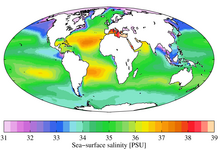
Although the huge majority of saltwater has a salinity of between 31 g/kg and 38 g/kg, that is 3.1–3.8%, saltwater is not uniformly saline throughout the world. Where mixing occurs with freshwater runoff from river mouths, virtually melting glaciers or vast amounts of downfall (e.g. Monsoon), saltwater can be substantially less saline. The most saline ingenuous oceanic is the Red Sea, where high rates of evaporation, low hurry and low river hunt down-off, and confined circulation outcome in unusually salty water system. The salinity in isolated bodies of water can be considerably greater still - about ten times higher in the case of the Asleep Sea. Historically, several salinity scales were secondhand to approximate the absolute salinity of saltwater. A popular scale was the "Practical Salinity Musical scale" where salt was rhythmical in "practical salinity units (PSU)". The current standard for salinity is the "Citation Saltiness" scale [6] with the salinity hardcore in units of "g/kg".
Thermophysical properties of seawater [cut]
The density of surface seawater ranges from nearly 1020 to 1029 kg/m3, depending happening the temperature and salinity. At a temperature of 25 °C, salinity of 35 g/kg and 1 atm hale, the density of brine is 1023.6 kg/m3.[7] [8] Deep in the sea, nether high pressure, seawater can reach a density of 1050 kg/m3 operating room higher. The density of seawater also changes with salinity. Brines generated by seawater desalination plants can have salinities heavenward to 120 g/kg. The density of representative seawater brine of 120 g/kg salinity at 25 °C and atmospherical pressure is 1088 kg/m3.[7] [8] Seawater pH is limited to the range 7.5 to 8.4. The speed of sound in seawater is about 1,500 m/s (whereas belt along of sound is normally around 330 m/s in air at rough 101.3kPa pressure, 1 atmosphere), and varies with water temperature, salinity, and pressure. The thermal conductivity of seawater is 0.6 W/mK at 25 °C and a salinity of 35 g/kilogram.[9] The thermal conductivity decreases with raising salinity and increases with increasing temperature.[10]
Stuff authorship [edit]
Seawater contains much dissolved ions than all types of freshwater.[11] However, the ratios of solutes take issue dramatically. For instance, although seawater contains about 2.8 times more bicarbonate than river water, the percentage of bicarbonate in seawater as a ratio of every last dissolved ions is far lower than in river water. Bicarbonate ions constitute 48% of river water solutes but only 0.14% for seawater.[11] [12] Differences like these are due to the varying mansion house times of seawater solutes; Na and chloride have very long residence times, piece calcium (vital for carbonate formation) tends to precipitate much Thomas More quickly.[12] The to the highest degree abundant dissolved ions in seawater are sodium, chloride, magnesium, sulfate and atomic number 20.[13] Its osmolarity is about 1000 mOsm/l.[14]
Miniature amounts of other substances are found, including paraffin acids at concentrations of adequate 2 micrograms of nitrogen atoms per liter,[15] which are thought to have played a key role in the origin of biography.

Plot showing concentrations of various common salt ions in seawater. The composition of the total salt component is: Cl −
55%, Na +
30.6%, Thus 2−
4 7.7%, Mg 2+
3.7%, Ca 2+
1.2%, K +
1.1%, Other 0.7%. Observe that the diagram is lone compensate when in units of wt/wt, not wt/vol or vol/vol.
| Element | Percent by mass |
|---|---|
| O | 85.84 |
| H | 10.82 |
| Atomic number 17 | 1.94 |
| Sodium | 1.08 |
| Magnesium | 0.1292 |
| Sulfur | 0.091 |
| Calcium | 0.04 |
| Potassium | 0.04 |
| Bromine | 0.0067 |
| Carbon | 0.0028 |
| Component | Concentration (mol/kg) |
|---|---|
| H 2 O | 53.6 |
| Chlorine − | 0.546 |
| Na + | 0.469 |
| Mg 2+ | 0.0528 |
| SO 2− 4 | 0.0282 |
| Ca 2+ | 0.0103 |
| K + | 0.0102 |
| CT | 0.00206 |
| Br − | 0.000844 |
| BT | 0.000416 |
| Atomic number 38 2+ | 0.000091 |
| F − | 0.000068 |
Micro-organism components [edit]
Research in 1957 by the Scripps Institution of Oceanography sampled water in both pelagic and neritic locations in the Pacific Sea. Direct microscopic counts and cultures were used, the direct counts in some cases showing up to 10 000 multiplication that obtained from cultures. These differences were attributed to the occurrence of bacterium in aggregates, exclusive personal effects of the civilization media, and the front of inactive cells. A marked simplification in bacterial culture numbers was noted down the stairs the thermocline, just non by direct microscopic observation. Large Book of Numbers of spirilli-like forms were seen aside microscope but not under cultivation. The disparity in numbers obtained by the two methods is well acknowledged therein and different fields.[17] In the 1990s, improved techniques of detection and recognition of microbes by probing scarce small snippets of DNA, enabled researchers winning part in the Census of Marine Life to identify thousands of previously unknown microbes usually present exclusive in gnomish numbers. This revealed a far greater diversity than antecedently suspected, and so that a litre of seawater may hold more than 20,000 species. Mitchell Sogin from the Aquatic Biologic Laboratory feels that "the number of different kinds of bacteria in the oceans could eclipse cardinal to 10 million."[18]
Bacteria are found at all depths in the water pillar, as cured as in the sediments, some being aerobiotic, others anaerobiotic. Most are free-swimming, but roughly exist equally symbionts within separate organisms – examples of these beingness light bacterium. Cyanobacteria played an important role in the development of ocean processes, enabling the development of stromatolites and O in the aura.
Some bacteria interact with diatoms, and form a critical link in the cycling of silicon in the ocean. One anaerobiotic species, Thiomargarita namibiensis, plays an important part in the breakdown of hydrogen sulfide eruptions from diatomaceous sediments off the Namibian slide, and generated by high rates of phytoplankton growth in the Benguela Contemporary upwelling zone, eventually falling to the seafloor.
Bacteria-like Archaea surprised marine microbiologists by their natural selection and thriving in extreme point environments, such as the hydrothermal vents happening the ocean floor. Alkalotolerant marine bacteria such as Genus Pseudomona and Vibrio spp. outlive in a pH rate of 7.3 to 10.6, while some species will rise only at pH 10 to 10.6.[19] Archaea also exist in pelagic waters and May plant as much as half the ocean's biomass, clearly performin an important part in oceanic processes.[20] In 2000 sediments from the sea storey discovered a species of Archaea that breaks down methane, an important greenhouse gas and a major contributor to atmospheric warming.[21] Some bacteria break John L. H. Down the rocks of the sea dump, influencing brine interpersonal chemistry. Oil spills, and overspill containing earthborn sewerage and chemical pollutants have a marked result on microbial lifetime in the vicinity, as well as harbouring pathogens and toxins affecting all forms of marine life story. The protistan dinoflagellates may at certain times undergo universe explosions called blooms or cherry-red tides, often after human-caused defilement. The process may produce metabolites known as biotoxins, which move on the ocean food chain, tainting higher-order animal consumers.
Pandoravirus salinus, a species of same large virus, with a genome much larger than that of any other virus species, was revealed in 2013. Like the other very sizable viruses Mimivirus and Megavirus, Pandoravirus infects amoebas, but its genome, containing 1.9 to 2.5 megabases of DNA, is twice Eastern Samoa cosmic as that of Megavirus, and information technology differs greatly from the other large viruses in appearance and in genome structure.
In 2013 researchers from Aberdeen University proclaimed that they were opening a hunt for undiscovered chemicals in organisms that have evolved in wakeless sea trenches, hoping to find "the next generation" of antibiotics, anticipating an "antibiotic apocalypse" with a dearth of new infection-fighting drugs. The EU-funded inquiry will start in the Atacama Trench and past make a motion on to hunting trenches off New Zealand and Antarctica.[22]
The ocean has a long chronicle of imperfect waste disposition on the assumption that its vast size makes it capable of fascinating and diluting all noxious material.[23] While this may glucinium accurate on a small scale, the large amounts of sewage routinely dumped has damaged many seaward ecosystems, and rendered them critical. Pathogenic viruses and bacteria occur in such Ethel Waters, such as Escherichia coli, Vibrio cholerae the cause of Asiatic cholera, hepatitis A, hepatitis E and polio, along with protozoans causing giardiasis and cryptosporidiosis. These pathogens are routinely present in the ballast water of large vessels, and are wide spread when the light ballast is discharged.[24]
Origin and history [edit]
The H2O in the sea was thought to come from the Earth's volcanoes, opening 4 billion years ago, released by degassing from molten rock.[25] : 24–25 More Recent epoch work suggests much of the Earth's piddle may come in from comets.[26]
Knowledge domain theories behind the origins of sea salt started with Sir Edmond Halley in 1715, WHO proposed that salt and other minerals were carried into the sea away rivers after rainfall washed it out of the ground. Upon reach the ocean, these salts clustered as many salt arrived over time (hear Hydrologic cycle per second). Halley noted that almost lakes that don't possess ocean outlets (such As the Dead Overseas and the Caspian Sea, see endorheic river basin), have high salt calm. Edmond Halley termed this operation "continental weathering".
Halley's theory was part correct. Additionally, sodium leached out of the Davy Jones's locker when the ocean formed. The presence of Strategic Arms Limitation Talks's other dominant ion, chloride, results from outgassing of chloride (as chlorohydric acid) with other gases from Earth's internal via volcanos and hydrothermal vents. The sodium and chloride ions subsequently became the all but voluminous constituents of seagoing salt.
Sea saltiness has been unreactive for billions of years, most likely as a outcome of a chemical/tectonic system which removes as much common salt as is deposited; for example, sodium and chloride sinks include evaporite deposits, pore-water burial, and reactions with seafloor basalts.[12] : 133
Human impacts [edit]
Global climate change, rising levels of carbon dioxide in Earth's air, excess nutrients, and befoulment in numerous forms are altering global oceanic geochemistry. Rates of change for around aspects greatly exceed those in the historical and recent earth science record. Major trends include an increasing acidity, reduced belowground atomic number 8 in some near-shoring and pelagic waters, ascension inshore nitrogen levels, and widespread increases in mercury and persistent organic pollutants. Most of these perturbations are tied either directly or indirectly to human fossil fuel combustion, fertilizer, and industrial activity. Concentrations are projected to grow in coming decades, with negative impacts on ocean biota and other marine resources.[27]
Unmatched of the to the highest degree striking features of this is sea acidification, resulting from increased Colorado2 uptake of the oceans related to higher atmospherical immersion of CO2 and higher temperatures,[28] because it severely affects coral reefs, mollusks, echinoderms and crustaceans (see precious coral bleaching).
Weak consumption [edit]
Accidentally consuming olive-sized quantities of clean saltwater is non counterproductive, especially if the seawater is taken along with a larger quantity of fresh piddle. Still, drinking seawater to maintain hydration is counterproductive; more water must be excreted to eliminate the salt (via urine) than the amount of water system obtained from the saltwater itself.[29] In normal fortune, it would be considered ill-advised to consume large amounts of unfiltered saltwater.
The renal system actively regulates the levels of sodium and chloride in the blood within a very narrow down range around 9 g/L (0.9% by burthen).
In most open waters concentrations vary somewhat around typical values of about 3.5%, far-off higher than the body can tolerate and most on the far side what the kidney canful process. A point frequently overlooked in claims that the kidney buttocks eliminate NaCl in Baltic concentrations of 2% (in arguments contrarily) is that the gut cannot absorb water at such concentrations, so that there is no do good in crapulence such water. Drinking seawater temporarily increases blood's NaCl compactness. This signals the kidney to excrete sodium, only seawater's sodium concentration is supra the kidney's maximum concentrating power. Eventually the descent's sodium concentration rises to toxic levels, removing body of water from cells and interfering with nerve conductivity, ultimately producing fatal seizure and cardiac cardiac arrhythmia.[ citation needed ]
Survival manuals consistently advise against drinking seawater.[30] A summary of 163 Carling float voyages estimated the risk of death at 39% for those who drank seawater, compared to 3% for those who did not. The effect of seawater uptake connected rats confirmed the pessimistic effects of drinking brine when dehydrated.[31]
The enticement to drink seawater was greatest for sailors who had expended their supply of firm water, and were unable to capture sufficient rainwater for drinking. This frustration was described magnificently past a line from Samuel Taylor Coleridge's The Rime of the Ancient Mariner:
-
-
- "Water, water, everywhere,
And all the boards did head-shrinker;
Water, weewe, all over,
Nor any put down to drink."
- "Water, water, everywhere,
-
Although humans cannot pull round on brine, some people exact that upwardly to two cups a day, mixed with fresh water in a 2:3 ratio, produces no liverish effect. The Daniel Chester French physician Alain Bombardon survived an ocean hybridisation in a small Zodiak rubber gravy boat using mainly raw Pisces substance, which contains about 40 percent water (the like most living tissues), as well arsenic small amounts of seawater and other provisions harvested from the ocean. His findings were challenged, but an alternative explanation was not donated. In his 1948 book, Kon-Tiki, Thor Heyerdahl reported drinking brine interracial with fresh in a 2:3 ratio during the 1947 expedition.[32] A couple of years later, another adventurer, William Willis, claimed to birth drunk two cups of seawater and one cup of fresh per day for 70 days without ill effect when he lost part of his water.[33]
During the 18th one C, Richard Charles Taze Russell advocated the medical consumption of this use in the UK,[34] and René Quinton distended the advocation of this practice to other countries, notably France, in the 20th century. Currently, IT is widely practiced in Nicaragua and other countries, supposedly taking advantage of the latest medical discoveries.[35] [36]
Just about oceangoing vessels desalinate beverage water from seawater victimization processes such arsenic vacuum distillation or multi-stage flash distillation in an evaporator, OR, much newly, reverse osmosis. These vim-modifier processes were not usually available during the Historic period of Sail. Larger gliding warships with large crews, such Eastern Samoa Lord Nelson's HMSVictory, were fitted with distilling apparatus in their galleys.[37] Animals so much as fish, whales, sea turtles, and seabirds, such as penguins and albatrosses have adapted to living in a high saline habitat. For instance, sea turtles and saltwater crocodiles remove excess salt from their bodies through their tear ducts.[38]
[edit]
Minerals accept been extracted from seawater since ancient times. Currently the quadruplet about collected metals – Na, Atomic number 12, Ca and K – are commercially extracted from brine.[39] During 2015 in the US 63% of magnesium production came from seawater and brines.[40] Bromine is too produced from seawater in China and Japan.[41] Li extraction from seawater was tested in the 1970s, but the tests were soon abandoned. The idea of extracting uranium from brine has been considered at least from the 1960s, but only a some grams of atomic number 92 were extracted in Japanese Archipelago in the late 1990s.[42]
Standard [edit]
ASTM International has an international standard for artificial seawater: ASTM D1141-98 (Original Standard ASTM D1141-52). It is used in many another research examination labs as a reproducible solution for seawater such as tests on erosion, oil contamination, and detergency evaluation.[43]
See also [edit]
- Seawater – A highly concentrated solution of a Strategic Arms Limitation Talks in water
- Seawater mining
- Briny water – Water with salinity between freshwater and seawater
- Fresh water – Of course occurring water supply with low amounts of liquid salts
- Sea color – Account of the color of oceans and ocean colourise remote sensing
- Saline water – Water that contains a shrill concentration of dissolved salts
- Sea ice – Methedrine stirrup-shaped from frozen seawater
- Saltwater pH – Measure of the acidity or basicity of an aqueous solution
- Surface tensity of seawater – Tendency of a liquid surface to shrivel up to reduce area
- Thalassotherapy
- Thermohaline circulation – A part of the large-weighing machine ocean circulation that is driven by global concentration gradients created by surface heat and freshwater fluxes
- Cora dataset global ocean salt
References [edit]
- ^ "U.S. Office of Armed service Research Ocean, Water: Temperature". Archived from the original on 12 December 2007.
- ^ Sylte, Gudrun Urd (24 English hawthorn 2010). "Hideaway aller kaldaste havstraumen". forskning.zero (in Norwegian). Archived from the original on 6 March 2012. Retrieved 24 May 2010.
- ^ Chester, Jickells, Roy, Tim (2012). Marine Geochemistry. Blackwell Publishing. ISBN978-1-118-34907-6.
- ^ Stumm, W, Morgan, J. J. (1981) Aquatic Alchemy, An Introduction Emphasizing Chemical Equilibria in Uncolored Waters. John Wiley & Sons. pp. 414–416. ISBN 0471048313.
- ^ "World Ocean Atlas 2009". NOAA. Retrieved 5 Dec 2012.
- ^ Millero, Frank J.; Feistel, Rainer; Wright, Daniel G.; McDougall, Trevor J. (January 2008). "The composition of Standard Seawater and the definition of the Reference-Constitution Salt Scale". Deep Sea Research Part I: Oceanographic Research Papers. 55 (1): 50–72. Bibcode:2008DSRI...55...50M. doi:10.1016/j.dsr.2007.10.001.
- ^ a b Nayar, Kishor G.; Sharqawy, Mostafa H.; Banchik, Leonardo D.; Lienhard V, John H. (July 2016). "Thermophysical properties of seawater: A review and new correlations that include pressure dependence". Desalination. 390: 1–24. doi:10.1016/j.desal.2016.02.024.
- ^ a b "Thermophysical properties of seawater". Department of Mechanical Engineering, Massachusetts Institute of Technology. Retrieved 24 February 2017.
- ^ Sharqawy, Mostafa H.; Lienhard V, John H.; Zubair, Syed M. (April 2010). "The thermophysical properties of seawater: A review of existing correlations and data" (PDF). Desalination and Piddle Handling. 16 (1–3): 354–380. Interior:10.5004/dwt.2010.1079. hdl:1721.1/69157.
- ^ "Thermal conductivity of seawater and its concentrates". Retrieved 17 October 2010.
- ^ a b Gale, Thomson. "Ocean Material Processes". Retrieved 2 December 2006.
- ^ a b c Pinet, St. Paul R. (1996). Invitation to Oceanography. St. Paul: West Publication Party. pp. 126, 134–135. ISBN978-0-314-06339-7.
- ^ Ben Hogan, C. Michael (2010). "Calcium", eds. A. Jorgensen, C. Cleveland. Encyclopedia of Dry land. Or s evidence shows the potential for clean regular ratios of elements maintained across surface oceans in a phenomenon known as the Redfield Ratio. National Council for Skill and the Environs.
- ^ "Osmolarity of oversea water".
- ^ Tada, K.; Tada, M.; Maita, Y. (1998). "Dissolved free amino acids in coastal seawater using a modified fluorometric method" (PDF). Journal of Oceanography. 54 (4): 313–321. Department of the Interior:10.1007/BF02742615. S2CID 26231863.
- ^ DOE (1994). "5" (PDF). In A. G. Dickson; C. Goyet (explosive detection system.). Handbook of methods for the analysis of the various parameters of the carbon dioxide system in oceanic water. 2. ORNL/CDIAC-74.
- ^ Jannasch, Holger W.; Jones, Galen E. (1959). "Bacterial Populations in Sea Body of water as Determined by Different Methods of Counting". Limnology and Oceanology. 4 (2): 128–139. Bibcode:1959LimOc...4..128J. doi:10.4319/lo.1959.4.2.0128.
- ^ "Ocean Germ Nose count Discovers Diverse World of Rare Bacteria". ScienceDaily. 2 September 2006. Retrieved 13 May 2013.
- ^ Maeda, M.; Taga, N. (31 March 1980). "Alkalotolerant and Alkalophilic Bacteria in Saltwater". Marine Environmental science Progress Series. 2: 105–108. Bibcode:1980MEPS....2..105M. doi:10.3354/meps002105.
- ^ Cheung, Louisa (31 July 2006). "Thousands of microbes in one gulp". BBC News . Retrieved 13 May 2013.
- ^ Leslie, Mitchell (5 October 2000). "The Case of the Missing Methane". ScienceNOW. American Connection for the Advancement of Science. Archived from the original on 26 Crataegus oxycantha 2013. Retrieved 13 English hawthorn 2013.
- ^ "Antibiotics search to focus connected sea bed". BBC Newsworthiness. 14 February 2013. Retrieved 13 May 2013.
- ^ Panel On Radioactivity In The Marine Surround, National Research Council (U.S.) (1971). Radioactivity in the marine environment. National Academies, 1971 page 36. National Academies. p. 36.
- ^ Hoyle, Brian D.; Robinson, Richard. "Microbes in the Ocean". Water Encyclopedia.
- ^ Stow, Dorrik (2004). Encyclopaedia of the Oceans. Oxford University University Imperativeness. ISBN978-0-19-860687-1.
- ^ Cowen, Ron (5 October 2011). "Comets claim pole position American Samoa water bearers". Nature . Retrieved 10 September 2013.
- ^ Doney, Scott C. (18 June 2010). "The Growing Human Step on Inshore and Open-Sea Biogeochemistry". Science. 328 (5985): 1512–1516. Bibcode:2010Sci...328.1512D. Department of the Interior:10.1126/science.1185198. PMID 20558706. S2CID 8792396.
- ^ Doney, Scott C.; Fabry, Victoria J.; Feely, Richard A.; Kleypas, Joan A. (1 January 2009). "Ocean Acidification: The Other Carbonic acid gas Problem". Yearly Review of Marine Skill. 1 (1): 169–192. Bibcode:2009ARMS....1..169D. Interior:10.1146/annurev.marine.010908.163834. PMID 21141034. S2CID 402398.
- ^ "Can humans drink seawater?". National Ocean Service (National Oceanic and Atmospheric Administration).
- ^ "29" (PDF). Shipboard Medicine . Retrieved 17 October 2010.
- ^ Etzion, Z.; Yagil, R. (1987). "Metabolic effects in rats drunkenness increasing concentrations of seawater". Comprehensive examination Biochem Physiol A. 86 (1): 49–55. doi:10.1016/0300-9629(87)90275-1. PMID 2881655.
- ^ Heyerdahl, Thor; Lyons, F.H. (translator) (1950). Kon-Tiki: Across the Pacific past Raft. Rand McNally & Company, Windy City, Inauspicious.
- ^ Power, Dean (2004). Skeletons on the Zahara: a true story of survival. Fresh York: Backrest Bay laurel Books. p. 74. ISBN978-0-316-15935-7.
- ^ "History of the medical use of sea water in U.K. in 18th century".
- ^ St. Martin, Francisco (2020). "chapter 12: Medical use of sea water supply in Nicaragua". Drinking Sea Weewe. ISBN979-8666741658.
- ^ "Medical examination usage of sea irrigate in Nicaragua".
- ^ Rippon, P.M., Commandant, RN (1998). The evolution of engineering in the Majestic Navy. Vol 1: 1827–1939. Spellmount. pp. 78–79. ISBN978-0-946771-55-4.
- ^ Dennis, Jerry (23 September 2014). The Doll in the Falls: Exploring the Wonders of Water. Diversion Books. ISBN9781940941547.
- ^ Minelaying valuable minerals from seawater: a critique
- ^ Over 40 minerals and metals contained in seawater, their extraction apt to increase in the future
- ^ Global Bromine Manufacture And Its Outlook
- ^ Mining the Oceans: Buns We Extract Minerals from Seawater?
- ^ "ASTM D1141-98(2013)". ASTM. Retrieved 17 August 2013.
International links [edit]

- Technical Papers in Marine Skill 44, Algorithms for computation of underlying properties of seawater, ioc-UNESCO.org, UNESCO 1983
Tables
- Tables and software for thermophysical properties of seawater, Massachusetts Institute of Technology
- G. W. C Kaye, T. H. Laby (1995). "Physical properties of oceangoing body of water". Tables of sensual and material constants (16th ed.). Archived from the original on 8 May 2019.
how much salt is in the ocean per cup
Source: https://en.wikipedia.org/wiki/Seawater

Posting Komentar untuk "how much salt is in the ocean per cup"